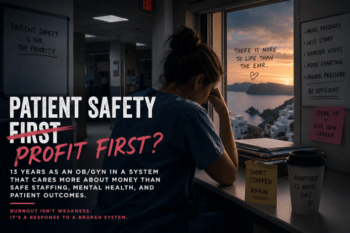
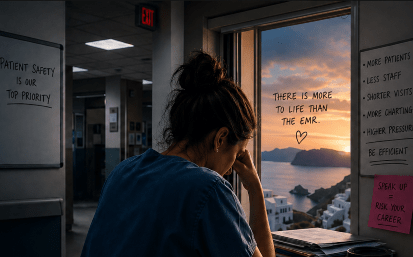
For the past 13 years, I’ve worked as an OB/GYN—bringing life into the world, guiding patients through some of their most vulnerable moments, and showing up every day in a system that, increasingly, feels like it’s working against both patients and providers.
I’m exhausted. And I know I’m not the only one.
When “Patient Safety First” Stops Matching Reality
There’s a phrase we hear constantly in healthcare:
“Patient safety is our top priority.”
It’s printed on posters. It’s in mission statements. It’s embedded in every mandatory module we click through late at night after a 12-hour shift.
And yet… somehow…the math isn’t mathing.
Behind the scenes, many of us are watching the opposite unfold:
- Fewer providers on call
- Higher patient volumes
- Shorter visit times
- Increasing documentation burdens
- Constant pressure to “be efficient” (translation: see more patients, generate more revenue)
And when frontline providers raise concerns?
Too often, they’re labeled:
- “Difficult”
- “Not a team player”
- Or hit with conveniently timed complaints
Advocating for patient safety shouldn’t feel like a career risk—but in many places, it does.
That disconnect isn’t just frustrating.
It’s morally exhausting.
This Isn’t Just Burnout — It’s Moral Injury
We’ve all heard the word burnout.
We’ve sat through the wellness lectures. Tried the apps. Drank the water. Considered yoga (briefly).
But what many healthcare workers are experiencing goes deeper than exhaustion.
It’s the weight of being asked to practice medicine in a way that doesn’t align with what we were trained to do.
It’s knowing what safe, thoughtful, thorough care looks like…
and being told to do it faster, with fewer resources, under increasing pressure.
That gap?
It has a name: moral injury.
And no amount of bubble baths fixes that.
The Culture of Silence Is Part of the Problem
One of the hardest parts of this system is what happens when someone actually speaks up.
You would hope the response would be:
“Thank you for advocating for patients.”
But more often, it feels like:
“Interesting. Anyway… let’s talk about your tone.”
When the system punishes the people who care the most, it sends a clear message:
Keep your head down. Don’t rock the boat. Move the line.
And that culture doesn’t just harm providers—it quietly erodes patient safety from the inside out.
You Cannot Out-Work a Broken System
Healthcare workers are resilient. Almost to a fault.
We function on:
- Too little sleep
- Cold coffee
- Adrenaline and responsibility
But the issue isn’t that we’ve suddenly lost resilience.
It’s that:
- Workloads have increased
- Support has decreased
- Emotional demands have intensified
- The margin for error has shrunk
You cannot out-resilience a system that is fundamentally misaligned.
And many of us have been trying for years.
The Emotional Toll No One Sees
There’s the version of us patients see—capable, composed, dependable.
And then there’s the reality:
- The tears after a shift
- The constant second-guessing
- The mental exhaustion that follows you home
- The quiet questioning of whether you can keep doing this long-term
Even watching medical shows lately, I’ve found myself tearing up—not because they’re dramatic, but because they feel uncomfortably accurate.
So What Can We Actually Do?
We may not be able to fix corporate healthcare overnight (although if you can, please let me know immediately).
But we can protect pieces of ourselves within it.
Find Your People
Those “are you seeing this too?” conversations matter more than you think. Shared reality reduces isolation.
Name What’s Actually Happing
There’s a difference between:
“I’m tired”
and
“I’m morally distressed because I can’t give the care my patients deserve.”
One is burnout. The other is grief.
Let Go of the Superhero Myth
You are not an unlimited resource. You’re a human being in a system that often forgets that.
Take Micro-Resets
No, you don’t have time for a 20-minute meditation.
But you do have 10 seconds:
- Unclench your jaw
- Drop your shoulders
- Take one slow breath
It won’t fix the system—but it might get you through the next patient.
My Favorite Prescription: Travel
This is where my story shifts—and honestly, where I’ve found some of my sanity.
I don’t travel because my life is perfect.
I travel because it’s not.
Because when you work in healthcare, your world can become painfully small:
Hospital → Charting → Sleep → Repeat
Travel interrupts that cycle.
It reminds you:
- There are places where no one is paging you
- Meals can be eaten sitting down
- Your identity exists outside of your job title
Whether it’s:
- A weekend road trip
- A quiet beach
- A new city with no agenda
- Or just booking a future trip so you have something to look forward to
Travel isn’t escape.
It’s perspective.
And sometimes, it’s survival.
Because nothing puts things into perspective quite like sitting in a quiet café somewhere thinking:
“Wow. No one here needs me to log into the EMR.”
You Are Not the Problem
If you’re in healthcare and you feel exhausted, disillusioned, or stretched too thin—
It doesn’t mean you’re weak.
It likely means:
- You care deeply
- You’re paying attention
- And you’re working in a system that is asking too much, for too long
The goal isn’t to stop caring.
The goal is to care—and protect yourself enough to keep going.
Final Thoughts
The system may be corporate.
But your compassion is still real.
And that still matters more than any metric, margin, or spreadsheet ever will.